
The foundation
Structure determines how clearly search engines understand your site.
Website structure is the hierarchical organization of your site's pages, and it directly determines how well search engines crawl, index, and rank your content. Design-related factors like architecture, mobile-friendliness, and semantic structure influence an estimated 30–40% of ranking outcomes. That number alone should reframe how you think about your site. Most small business owners focus on content and keywords while ignoring the foundation those elements sit on. Getting the structure right is the single most reliable way to build lasting organic visibility. This guide walks you through the models, the planning, and the execution you need to structure your website for SEO growth from the ground up.
Choose the right foundation
What are the best website structure models for SEO?
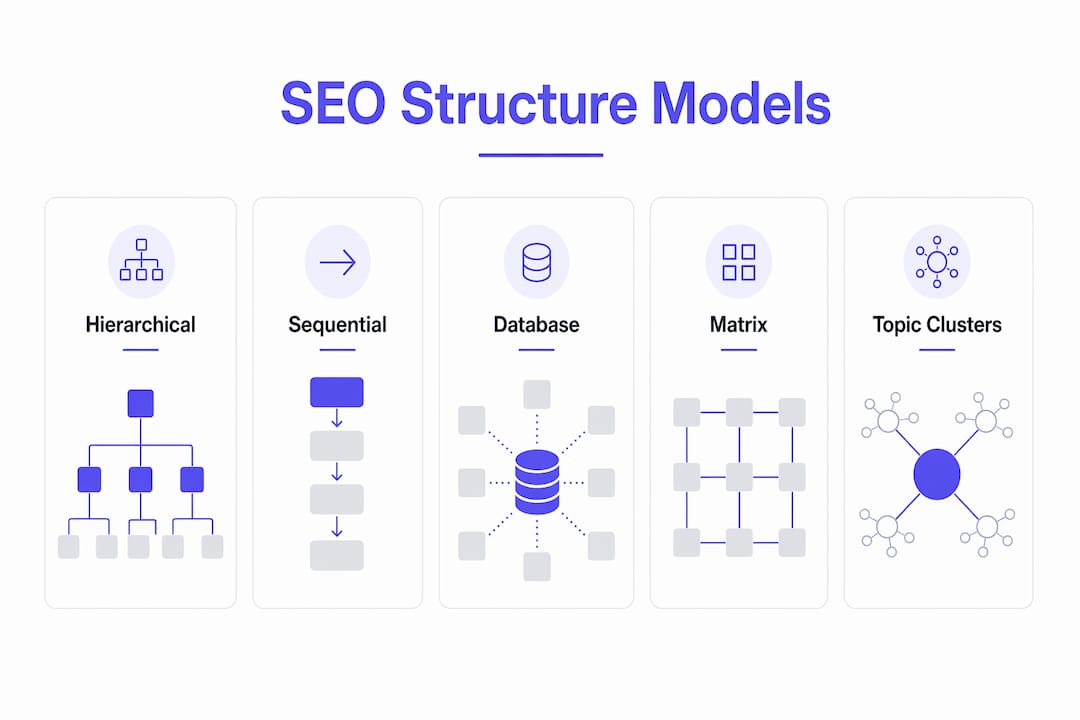
Website architecture for SEO comes in four main forms: hierarchical, sequential, database, and matrix. The hierarchical model is the most effective for search engine optimization. It organizes pages from a broad homepage down through category pages and into specific content pages, mirroring how both users and crawlers naturally move through a site.
The topic cluster model builds on the hierarchical foundation and represents the current standard for topical authority. A pillar page covers a broad subject in depth, while 10 to 50 or more supporting pages address specific subtopics and link back to the pillar. Well-structured content clusters attract up to 75% of total SERP clicks in competitive categories. That concentration of traffic happens because search engines read the cluster as a signal of genuine expertise on a subject.

| Structure type | SEO strength | Best for |
|---|---|---|
| Hierarchical | High | Most small business sites |
| Topic cluster | Very high | Content-driven and service sites |
| Sequential | Low | Single-path funnels only |
| Matrix (web) | Low | Can confuse crawlers; avoid for SEO |
Topic clusters and hybrid silo structures outperform strict silos because they balance topical boundaries with natural user discovery. A strict silo keeps categories completely separate, which can limit the internal link equity flowing between related pages. A hybrid approach lets you cross-link where it genuinely helps the reader, without breaking the overall hierarchy.
Map topics before pages
How do you plan your site structure using keyword clusters?
Keyword research is the starting point for any SEO-friendly website design. Group your target keywords by topic, not just by search volume. Each cluster of related keywords maps to one pillar page and several supporting pages. This process defines your site's hierarchy before you write a single word of content.
Your main navigation menu should reflect your top five to seven keyword-driven topics. These become your pillar pages. Supporting pages sit one level below in the URL structure and address specific questions or subtopics within each pillar. Descriptive, keyword-rich URL paths avoid parameters and support both crawlability and user trust. A URL like /services/seo-web-design communicates hierarchy and relevance far better than /page?id=42.
Breadcrumbs reinforce that hierarchy visually and technically. BreadcrumbList schema markup can be added sitewide beneath the homepage level, giving search engines a structured data signal about page relationships. This often improves how your pages appear in search results, with the breadcrumb path showing directly in the snippet.
Planning checklist
- Map every target keyword to a specific page type (pillar or supporting)
- Limit your main navigation to five to seven items
- Write clean, descriptive URLs for every page
- Add BreadcrumbList schema to all inner pages
- Confirm no two pages target the same primary keyword
Put the plan into practice
How to build an SEO-friendly website structure step by step
Execution starts with three page levels: the homepage, hub or pillar pages, and cluster or supporting pages. Each level has a distinct role. The homepage targets your broadest brand and category keywords. Pillar pages target broad topic keywords. Supporting pages target specific, long-tail queries within each topic.
Create your homepage
Use a clear H1, primary keyword, and links to each pillar page in the main navigation.
Build pillar pages
Create one for each major topic cluster. Each pillar page should link out to all its supporting pages.
Publish supporting pages
Each page should link back to its parent pillar and to two or three related supporting pages within the same cluster.
Add breadcrumbs
Place them on every inner page and pair them with BreadcrumbList schema markup.
Write unique search metadata
Give every page its own title tag and meta description. No two pages should share these.
Audit internal links
Use descriptive anchor text. Keyword-relevant anchor text distributes page authority and guides crawlers more effectively than generic phrases like “click here.”
Verify the 1–3 click rule
Priority pages must be reachable within one to three clicks from high-authority hub pages. Pages buried deeper than three clicks receive significantly less crawl attention and link equity.
Orphan pages and link rot are the two most damaging structural problems a small business site can have. An orphan page has no internal links pointing to it, so crawlers may never find it. Link rot happens when internal links point to deleted or moved pages, wasting crawl budget and frustrating users. Schedule a structural audit every quarter to catch both problems before they compound.
Design systems that codify SEO best practices into reusable components prevent these errors at scale. When heading hierarchy, breadcrumbs, and semantic HTML are built into your page templates, every new page you publish inherits the correct structure automatically.
The Smith Digitals team applies this exact approach when building sites for small businesses. The Stone Mountain Yogurt case study shows how structural decisions made during the design phase produced measurable SEO gains after launch.
Find what holds growth back
What are the most common website structure mistakes and how do you fix them?
Deep nesting is the most common structural mistake small business sites make. When important pages sit four or five levels below the homepage, crawlers deprioritize them and users struggle to find them. Flatten your hierarchy so that no priority page is more than three clicks from the homepage.
Keyword cannibalization is the second most damaging problem. It happens when two or more pages target the same primary keyword, splitting authority and confusing search engines about which page to rank. Audit your pages regularly and consolidate or redirect duplicates.
- Bloated navigation: More than seven items in the main menu dilutes crawl priority across too many pages.
- Orphan pages: Any page with zero internal links pointing to it is invisible to crawlers.
- Generic anchor text: Phrases like “read more” or “learn more” pass no keyword signal to search engines.
- Missing breadcrumbs: Inner pages without breadcrumbs lose a structured data opportunity.
- Duplicate title tags: Every page needs a unique title tag. Duplicates signal thin or redundant content.
AI search engines analyze URL paths and heading hierarchies to determine a page's topical authority and eligibility for citation. This means clear site structure is no longer just a Google requirement. ChatGPT, Perplexity, and similar tools use the same structural signals when deciding which pages to surface in AI-generated answers. A flat, explicit hierarchy gives your content the best chance of being cited.
The essentials
Key takeaways
A well-planned hierarchical structure with topic clusters is the single most reliable foundation for sustained SEO growth and organic traffic.
| Point | Details |
|---|---|
| Structure drives rankings | Architecture and design factors influence an estimated 30–40% of SEO performance outcomes. |
| Topic clusters win | Pillar pages with 10 or more supporting pages build topical authority and attract the majority of SERP clicks. |
| Apply the 1–3 click rule | Every priority page must be reachable within three clicks from a high-authority hub page. |
| Use descriptive URLs and anchors | Keyword-relevant URLs and anchor text improve crawlability and distribute link equity effectively. |
| Build SEO into templates | Embedding heading hierarchy and breadcrumbs into page templates prevents structural errors at scale. |
From experience
What I've learned from watching small businesses get structure wrong
Most small business owners treat website structure as a design decision rather than an SEO decision. They build a site that looks good and then wonder why it does not rank. The visual layer and the structural layer are two separate things, and confusing them is expensive.
The pattern I see most often is a homepage with a beautiful hero image, a navigation menu with ten or twelve items, and no clear hierarchy beneath it. Every page is roughly equal in the site's internal link graph, which means no page has enough authority to rank for anything competitive. The fix is not more content. The fix is consolidation and hierarchy.
What I find genuinely exciting about 2026 is that AI search engines have made structural clarity even more valuable. AI engines assess page authority through URL structure and heading hierarchy, which means the same work that helps Google also helps your content get cited by ChatGPT and Perplexity. You are not optimizing for two separate systems. You are optimizing for one principle: clarity.
The businesses I have seen grow fastest through organic search are the ones that treated structure as a living system. They scheduled quarterly audits, updated their clusters as their services evolved, and linked new pages into the existing hierarchy from day one. That discipline compounds over time in a way that no single piece of content ever can.
Start with your pillar pages. Get those right. Then build outward. The BBS Bakery case study is a good example of what happens when a small business commits to that process with the right team behind them.
— Dylan
Build for search from day one
How Smith Digitals helps small businesses build for SEO from the start
Smith Digitals specializes in SEO-friendly web design built specifically for small businesses and entrepreneurs. Every site they build starts with a structural plan, not a visual one. That means keyword clusters, clean URL hierarchies, breadcrumb schema, and internal linking strategies are all in place before the first page goes live.

Small business owners who work with Smith Digitals get a site that is built to rank, not just to look good. The pricing plans are designed for businesses at different stages of growth, from a first website to a full content marketing system. If you want a site that earns organic traffic from day one, Smith Digitals is worth a conversation.
Common questions
Frequently asked questions
What is website structure in SEO?
Website structure is the hierarchical organization of your site's pages and the internal links connecting them. It determines how search engines crawl your content and how users navigate between pages.
How does site hierarchy affect search rankings?
A clear hierarchy signals topical authority to search engines and concentrates link equity on your most important pages. Architecture decisions influence an estimated 30–40% of overall SEO performance.
What is the topic cluster model?
The topic cluster model uses one broad pillar page linked to multiple supporting pages on related subtopics. This structure builds topical authority and can significantly increase the share of SERP clicks a site attracts.
How many clicks should it take to reach any page?
Priority pages should be reachable within one to three clicks from a high-authority hub page. Pages buried deeper than three clicks receive less crawl attention and rank less effectively.
Does website structure matter for AI search engines?
Yes. AI search engines like ChatGPT and Perplexity use URL paths and heading hierarchies to assess topical authority. A flat, explicit site hierarchy improves your content's eligibility for AI-generated citations and summaries.
Keep exploring